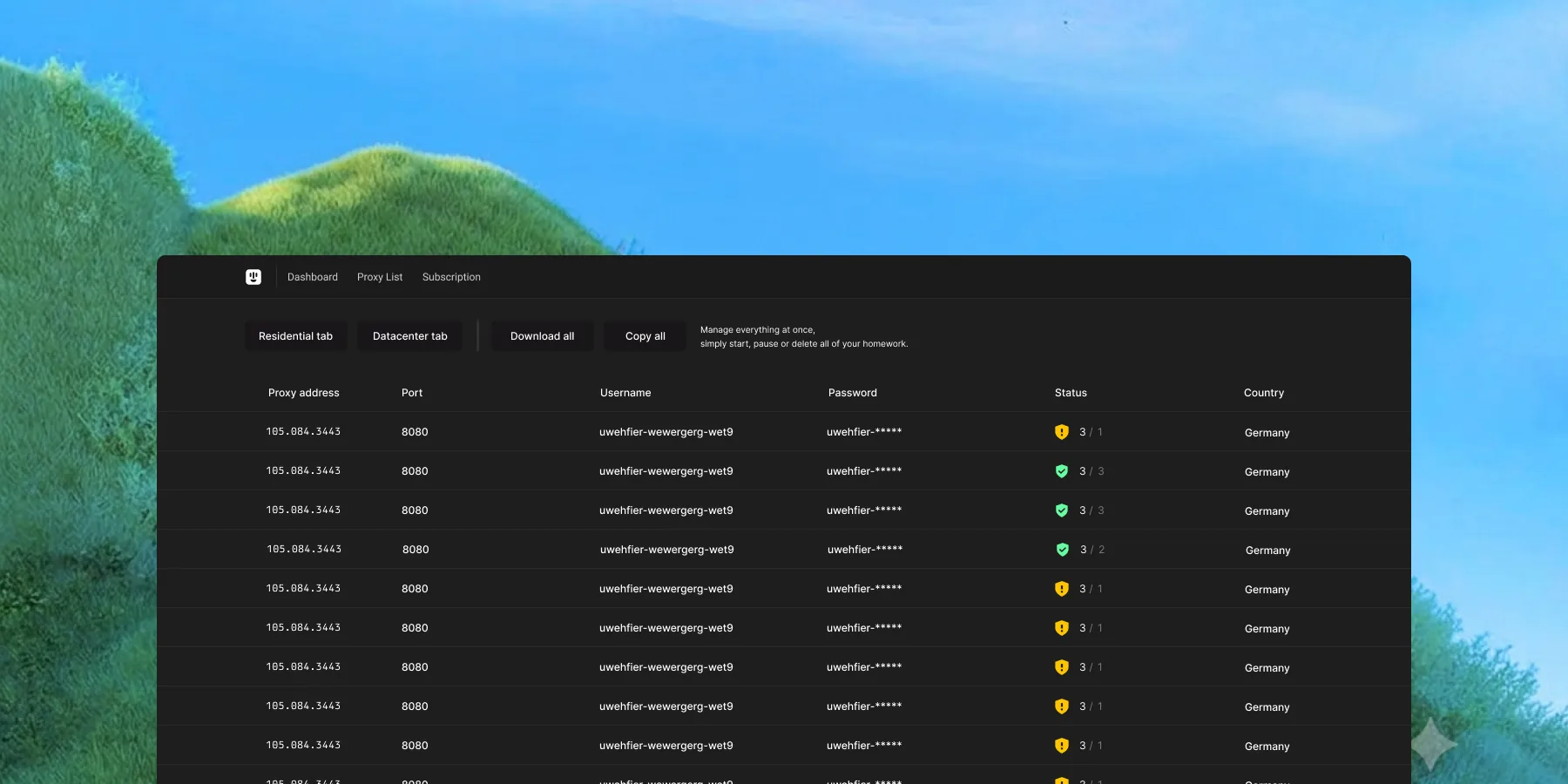
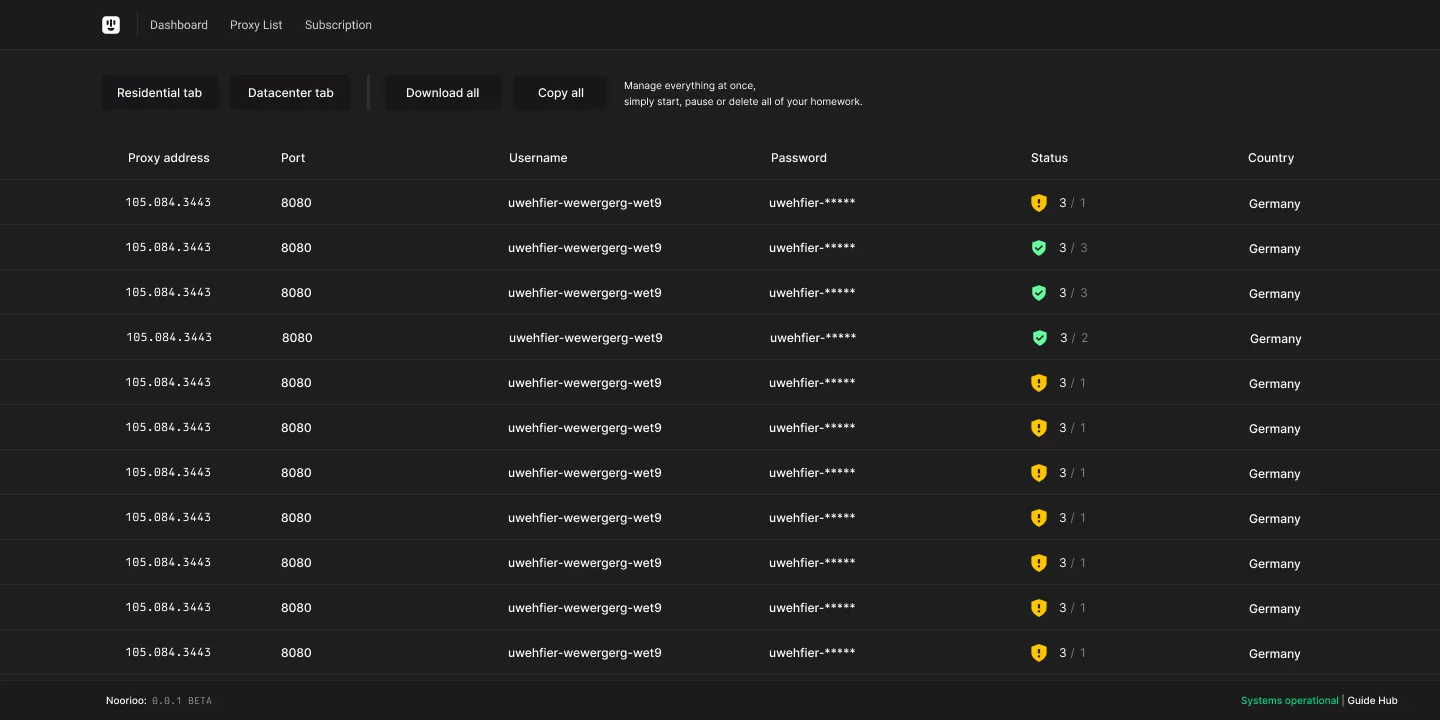
Backend developers, API integration specialists, web scraping engineers, and DevOps automation teams utilize Curl proxies. Roundproxies provides reliable proxy infrastructure specifically optimized for command-line HTTP operations, enabling authenticated requests, API testing, and automated data collection through Curl without exposing origin servers.
Free proxies cause Curl operations to fail with SSL handshake errors, timeout issues, and inconsistent availability that breaks automated workflows. Roundproxies delivers enterprise-grade HTTP/HTTPS proxies with guaranteed uptime, proper certificate handling, and protocol support essential for production Curl implementations.
Optimized for command-line efficiency, our Curl-compatible proxy network provides low-latency HTTP connections with minimal overhead. Support for all Curl proxy protocols including HTTP, HTTPS, and SOCKS5 ensures seamless integration. Connection pooling and keep-alive support maximize throughput for batch operations and automated scripts.
Datacenter proxies excel for Curl operations requiring speed and reliability—perfect for API testing, webhook validation, and high-frequency scraping. Residential proxies add legitimacy when Curl scripts must appear as regular users. Our infrastructure supports all Curl authentication methods including basic auth, digest, and bearer tokens.
curl talks to every proxy type we run, and the decisions that matter are the same ones a browser would face: which address type the target accepts, whether the address should hold across calls, and whether DNS goes through the proxy. The one curl-specific trap is DNS — a SOCKS proxy without remote resolution leaks every hostname you request from your own machine. Everything else is about choosing the type per target.
| Proxy type | Verdict | Why |
|---|---|---|
| Datacenter | APIs and soft targets | Fast, unmetered and the natural fit for curl's most common jobs — API calls, health checks, downloads from sites without bot management. |
| Rotating residential | Protected sites, per call | A fresh address on every invocation through the rotating endpoint. For scripted fetches against sites that score the address. |
| Sticky residential | Multi-call sessions | A session parameter in the credentials holds one address across calls, which is what a login-then-fetch script needs alongside a cookie jar. |
| ISP (static residential) | Long-running scripts | A fixed address for a cron job or monitor that should always come from one place, with no session handling. |
| 4G / 5G mobile | Rarely from curl | Most mobile-only targets also check the client, which curl does not imitate. Only where the address alone is the gate. |
Fast, unmetered and the natural fit for curl's most common jobs — API calls, health checks, downloads from sites without bot management.
A fresh address on every invocation through the rotating endpoint. For scripted fetches against sites that score the address.
A session parameter in the credentials holds one address across calls, which is what a login-then-fetch script needs alongside a cookie jar.
A fixed address for a cron job or monitor that should always come from one place, with no session handling.
Most mobile-only targets also check the client, which curl does not imitate. Only where the address alone is the gate.
Datacenter by default, residential where the target demands it, sticky or ISP where the calls form a session.
Protocol choice, DNS resolution, and session persistence — the three things that go wrong.
Our endpoints accept both. HTTP proxies with credentials are the simplest and work everywhere; SOCKS5 carries any TCP protocol, not only HTTP, which matters for non-web tools called from the same scripts.
Proxy setup: HTTP with credentials for web fetches. SOCKS5 when the script also drives non-HTTP tools through the same address.
With a plain SOCKS proxy, curl resolves the hostname locally and sends the address to the proxy — leaking every hostname to your own resolver and geolocating the lookup to your machine. The remote-resolution variant sends the hostname through the proxy instead.
Proxy setup: Always use the remote-resolution form of SOCKS (the 'h' variant) or an HTTP proxy, which resolves remotely by design.
curl is stateless between invocations. A script that logs in and then fetches needs the same address and the same cookies across calls.
Proxy setup: A sticky session parameter in the proxy credentials plus a cookie jar file shared across the calls.
curl reaches everything; the target decides what it accepts. Test one call from datacenter and one from residential before scripting.
Use the remote-resolving SOCKS scheme or an HTTP proxy. A local resolution is a leak and a geolocation mismatch.
Our sticky endpoints take a session identifier in the username. Reuse it across the calls that belong together, with a shared cookie jar.
The rotating endpoint gives a new address per connection. Independent scripted fetches should use it rather than holding an address they do not need.
A residential address with curl's default user agent is blocked by targets that score the client. Set a browser user agent and accept headers where the target cares.
Proxy credentials in a shell argument appear in process listings. Use a config file or environment variables.
Sized on concurrency for static addresses, on bytes for residential.
| What you are running | Proxies you need | Notes |
|---|---|---|
| Cron monitors and API calls | 1–5 datacenter or ISP | A few fixed addresses. The trial covers it. |
| Scripted fetches against protected sites | Rotating residential by GB | Size on responses times average response size. |
| Login-then-fetch scripts | Sticky residential per concurrent script | One held session per script running at once. |
| Parallel downloads from soft targets | Datacenter per parallel stream | Unmetered addresses, one per concurrent connection. |
1–5 datacenter or ISP
A few fixed addresses. The trial covers it.
Rotating residential by GB
Size on responses times average response size.
Sticky residential per concurrent script
One held session per script running at once.
Datacenter per parallel stream
Unmetered addresses, one per concurrent connection.
Plain SOCKS resolution leaking hostnames and geolocation.
Holding a sticky address for fetches that did not need one.
Rotating between the login call and the fetch call.
Residential traffic under curl's default user agent on targets that score the client.
Datacenter addresses on a target that blocks them, then scripting retries.
Credentials on the command line of a shared machine.
Premium proxy solutions for your business needs
Fast & large proxy pool

Unlimited concurrent sessions

Bypass toughest targets using trusted ASN provider IPs.

Real mobile device IPs with free geo-targeting.
Cost-efficient & high performance
See what our customers have to say about our services. Trusted by thousands of businesses worldwide.

tbh, I had a very good run with roundproxies. the support is top tier and the quality of the proxies ahve been premium since day one. Have used their ISP and Residential proxies and love the granuliar targeting I can do. I would recommend roundproxies.
The proxy quality and success rate is what stands out most. The IPs are clean, connections are fast, and I rarely hit blocks even on tougher targets. The dashboard is dead simple, I was up and running in minutes, and whenever I had a setup question, support answered within minutes and actually knew what they were talking about. For the price, especially the datacenter proxies with unlimited bandwidth, the value is hard to beat.
I purchased proxies today the first time in my life, not knew where to start. Marius responded within minutes and helped me understand everything right away. Very fast and helpful support.
The Datacenter Proxies arrived and missing an item. I immediately contacted customer service who sent me another Datacenters for and added one week for free on top.
Automate competitive API monitoring through Curl scripts that track competitor service availability, response times, and endpoint changes. Build market intelligence pipelines that aggregate data from multiple public APIs while distributing requests across proxy infrastructure to avoid rate limiting. Schedule recurring Curl jobs for price monitoring, product availability checks, and data feed validation.
Verify ad server endpoints, validate tracking pixel implementations, and test geo-targeted content delivery through Curl requests from distributed proxy locations. Monitor CDN performance, check CORS header configurations, and audit API security implementations. Essential for ad tech platforms ensuring proper campaign delivery and tracking accuracy.
Access region-restricted APIs, test international endpoint availability, and validate geo-specific content delivery through Curl commands executed via proxies. Critical for distributed systems testing, multi-region service validation, and ensuring APIs respond correctly to requests from various geographic locations and network conditions.
Cost
Success Rate
Setup Time
Support Quality
Premium Providers
>$500/month minimum
High (95%+)
Complex setup
Budget Providers
$50-200/month
Variable (70-85%)
Quick but limited docs
From $3/month
99.9% uptime
1 min setup
24/7 live support
Cost
>$500/month minimum
Success Rate
High (95%+)
Setup Time
Complex setup
Support Quality
Cost
$50-200/month
Success Rate
Variable (70-85%)
Setup Time
Quick but limited docs
Support Quality
Cost
From $3/month
Success Rate
99.9% uptime
Setup Time
1 min setup
Support Quality
24/7 live support
With plain SOCKS it does: curl resolves the hostname locally and sends the address to the proxy, exposing every hostname to your own resolver and geolocating the lookup to your machine. Use the remote-resolution variant of SOCKS, the scheme ending in h, or an HTTP proxy, which resolves remotely by design.
Put a session identifier in the proxy username on our sticky endpoints and reuse it across the calls that belong together, alongside a shared cookie jar file. curl is stateless between invocations, so a login-then-fetch script needs both the same address and the same cookies.
HTTP with credentials for web fetches; it is the simplest and works everywhere. SOCKS5 when the same script also drives non-HTTP tools through the same address, because it carries any TCP protocol. Either way, resolve DNS through the proxy, and send a session identifier in the username when several calls need to share one address.
Because curl's default user agent is scored by targets that check the client, and a residential address under a bare client is blocked as fast as a datacenter one. Set a browser user agent and accept headers where the target cares, and match the address type to the target rather than the tool.
Not on a shared host. Credentials in a shell argument appear in process listings for other users. Put them in a curl config file or in environment variables instead, keep the config file's permissions restricted to your own user, and never paste a full proxy URL into a shared shell history.
Need broader coverage than Curl alone? Datacenter Proxies work across every target site.
Explore our global proxy network spanning 195+ countries across all continents
Trusted by fast-growing teams and data professionals worldwide

 Log in