




Most of your traffic isn't human. Depending on whose report you read, automated requests now make up somewhere between 40% and 60% of everything hitting a typical site, and a big chunk of that is hostile: scrapers, credential-stuffing runs, fake signups, checkout bots.
Picking the best anti-bot solutions comes down to one honest question: how much friction are you willing to trade for how much protection? Some tools stop almost everything but nag real users with CAPTCHAs. Others stay invisible but ask you to trust a black box.
I've spent years on the other side of these systems - building scrapers that had to get past them. That vantage point is useful here. When you've spent a week trying to defeat a fingerprinting model, you learn quickly which vendors are hard to beat and which ones fold to a headless browser and a decent proxy pool.
Below are eight tools worth your shortlist, each with a clear "best for" so you can jump to the one that fits. One of them you can even self-host.
What is an anti-bot solution?
An anti-bot solution is software that inspects every request to your site, app, or API and decides in real time whether a human or a machine sent it. It scores signals like device fingerprints, behavior, and network reputation, then blocks or challenges anything that looks automated - ideally without slowing real users down. Start with detection accuracy and false-positive rate.
The best anti-bot solutions at a glance
- Blockdash for invisible, CAPTCHA-free protection
- Cloudflare Bot Management for teams already on Cloudflare
- Fastly for developer-first teams at the edge
- HUMAN Security for account and ad fraud
- AWS WAF Bot Control for apps already on AWS
- Akamai Bot Manager for large enterprise on the edge
- Arkose Labs for the hardest, highest-value attacks
- CrowdSec for teams that want to self-host
What makes a good anti-bot solution?
How I evaluated these
I didn't run a lab bake-off across all eight - anyone claiming they did in a single afternoon is lying to you. Instead this list draws on vendor documentation, the Q2 2026 Forrester Wave for Bot and Agent Trust Management (which named DataDome, HUMAN, and Kasada as Leaders), public benchmark reports, and my own hands-on experience trying to bypass these systems from the scraping side.
Full disclosure: Blockdash is featured first as the top pick for its category. The rest are ordered by fit, not by who's paying. Treat every "best for" as a starting point, then run a trial against your own traffic before you commit.
What separates the good from the useless
Detection accuracy. A tool that blocks bots but also blocks 2% of real customers is a liability. Look for a documented false-positive rate, not a vague "99.9%" slogan.
Friction. Every CAPTCHA you show costs conversions. The best modern tools challenge less than a fraction of a percent of requests and stay invisible otherwise.
Coverage. Attackers move to your softest surface. If a tool protects your website but not your login API or mobile app, they'll just hit the API.
Resistance to retooling. Static rules get reverse-engineered in a weekend. The tools that last use defenses that change shape, so yesterday's bypass stops working.
Cost you can predict. Several vendors bill on request volume, which means a bot attack can spike your invoice. Read the pricing model before the attack, not during it.
The best anti-bot solutions compared
| Tool | Best for | Standout feature | Pricing |
|---|---|---|---|
| Blockdash | Invisible protection | No-CAPTCHA, sub-2ms decisions | Custom quote; 30-day guarantee |
| Cloudflare | Existing Cloudflare users | Huge network visibility | Bot features from Pro ($20/mo); full mgmt Enterprise |
| Fastly | Developer-first teams | Pre- and post-cache inspection | Quote-based; usage-billed |
| HUMAN | Account/ad fraud | Cross-network threat intel | Custom; enterprise |
| AWS WAF Bot Control | AWS-hosted apps | Transparent per-request pricing | $10/mo per ACL + per-request |
| Akamai | Large enterprise | Edge-integrated at scale | Add-on contract |
| Arkose Labs | Highest-value targets | Adaptive challenges | Custom; enterprise |
| CrowdSec | Self-hosting | Open-source, crowd-shared IPs | Free; paid tiers optional |
Best anti-bot solution for invisible protection
Blockdash (Web, mobile, API)
Pros:
- No CAPTCHAs - real users never see a challenge
- Decisions in under 2ms, so it doesn't add noticeable latency
- Covers web, mobile, and APIs from one setup
Cons:
- Newer than the Forrester Leaders, with a shorter public track record
- Pricing is quote-only, so you can't self-estimate before a sales call
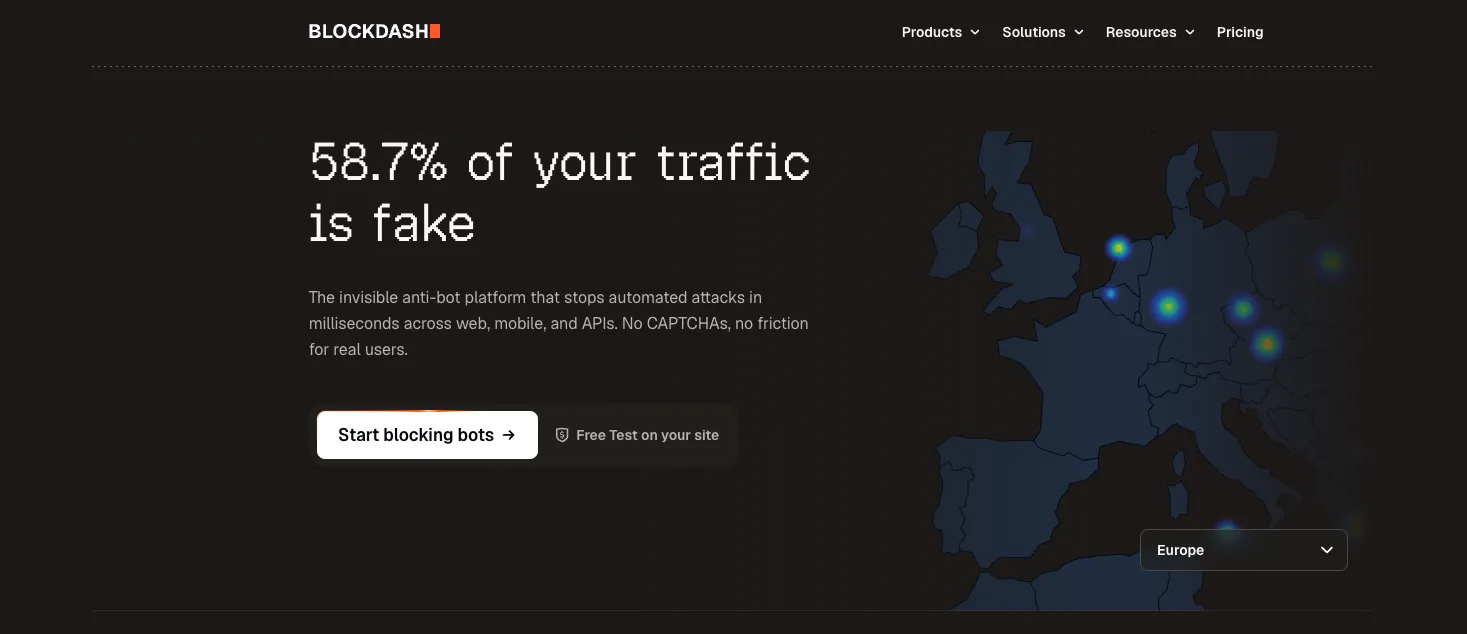
Blockdash is an invisible anti-bot platform. Instead of throwing a puzzle at anyone who looks suspicious, it scores each request silently and blocks the automated ones before your server responds.
That "invisible" part matters more than vendors usually admit. From the scraping side, a CAPTCHA is almost a gift - it tells you exactly where the wall is, and CAPTCHA-solving services cost fractions of a cent. A silent block is harder to even detect, let alone defeat.
The technical pitch is a set of ML models scoring intent, behavior, and fingerprints on a shared network, so a new attack pattern learned on one site gets blocked across all of them. Setup is meant to take under an hour, with 80+ integrations for common stacks.
Where I'd temper expectations: Blockdash hasn't been through the same years of public red-teaming as DataDome or Kasada. The approach is sound and the no-friction angle is genuinely strong, but if you're defending a top-10 ticketing on-sale against funded attackers, you'll want to trial it hard against your real threat model first.
Who it's for: teams that hate CAPTCHAs, want fast deployment, and care about protecting real-user experience as much as blocking bots. That's most e-commerce and SaaS sites, honestly.
It earns the top slot here because it optimizes for the thing most tools get wrong - keeping legitimate users completely untouched while the blocking happens in the background.
Blockdash pricing: Custom quote based on traffic and plan, with a 30-day money-back guarantee. No public free tier.
Best anti-bot solution for existing Cloudflare users
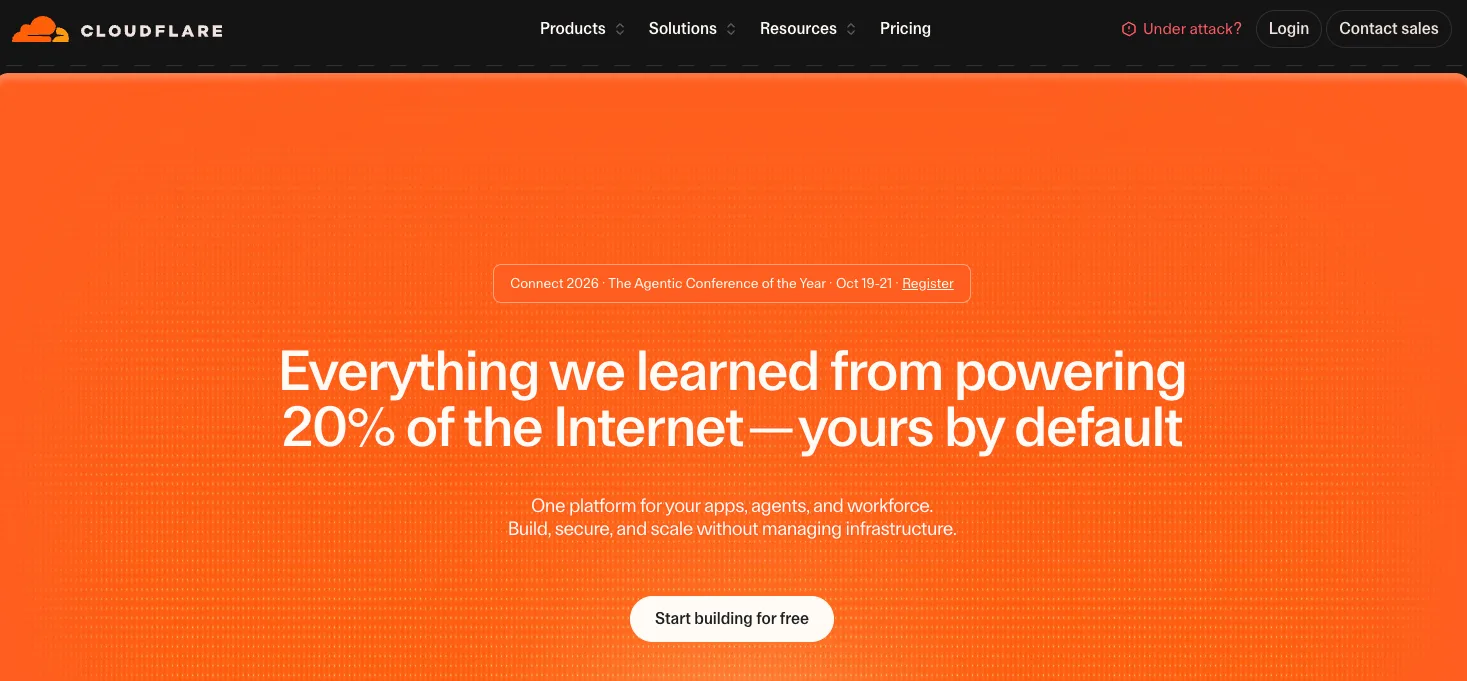
Cloudflare Bot Management (Web, API)
Pros:
- Sits inside a network already fronting a large share of the web
- Combines ML, fingerprinting, heuristics, and behavior analysis
- No extra vendor if Cloudflare already proxies your traffic
Cons:
- Full behavioral bot management is an Enterprise-tier feature
- Lighter bot tools on cheaper plans won't stop sophisticated automation
If Cloudflare already sits in front of your site, its bot management is the path of least resistance. It scores traffic using signals gathered across an enormous slice of internet requests, which gives it reach few competitors can match.
The catch is tiering. Some basic bot controls appear on the Pro plan around $20/month, but the behavioral engine that actually stops determined scrapers lives in Enterprise. Don't assume the cheap tier gives you the real thing.
For anyone running a scraper, Cloudflare's managed challenge and Turnstile are the walls you hit most often. Getting past them cleanly is a whole discipline - see our guide on how to bypass Cloudflare for the defender's-eye view of what that actually takes.
Who it's for: teams already on Cloudflare who want protection without adding a vendor, and who can justify the Enterprise jump for full coverage.
Cloudflare pricing: Some bot features from Pro ($20/month per domain); full Bot Management requires Enterprise (custom).
Best anti-bot solution for developer-first teams
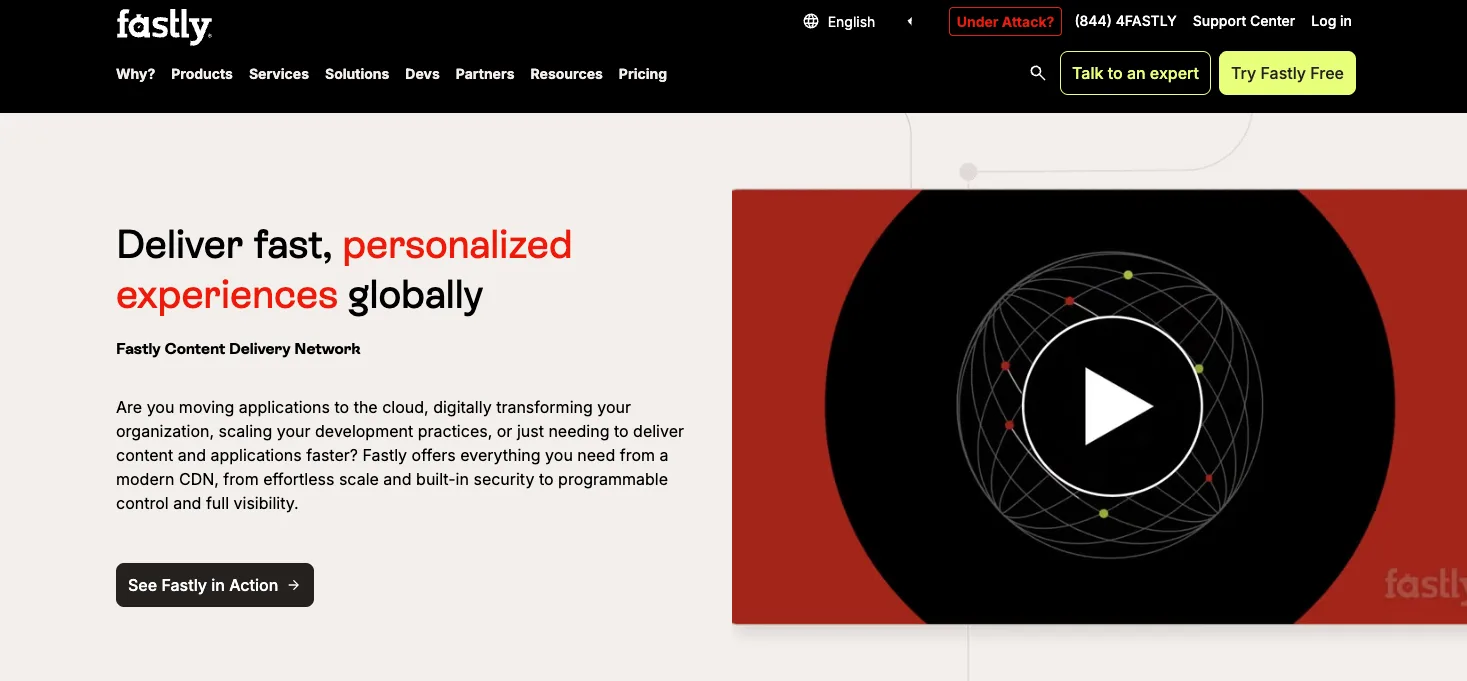
Fastly Bot Management (Web, API)
Pros:
- Choice of pre-cache or post-cache inspection, so you control what gets analyzed
- Pairs with the Next-Gen WAF (the old Signal Sciences engine), which reviewers rate highly on ease of use
- Strong fit for API-heavy apps and teams with a real DevOps culture
Cons:
- Quote-only pricing, and users on G2 flag the cost as high
- Post-cache inspection requires buying the Next-Gen WAF too
Fastly bolts bot management onto its edge network, and the deployment choice is the interesting part. Pre-cache inspection screens traffic before it touches your cache; post-cache inspection only analyzes cache misses heading to your origin.
That second mode is a smart cost lever. If most of your traffic serves from cache anyway, you're only paying to inspect the requests that would actually hurt your origin. Not many vendors give you that dial.
The security engine behind it is Signal Sciences, which Fastly acquired and rebranded as the Next-Gen WAF. It has a reputation for being pleasant to operate - good API access, sane alerting, the kind of thing engineers configure rather than file a ticket about.
The friction is commercial. There's no published price, billing follows usage, and more than one G2 reviewer has called it expensive. Post-cache inspection also needs the Next-Gen WAF as a prerequisite, so scope the full bundle before you budget.
Who it's for: engineering-led teams already delivering on Fastly who want bot defense they can wire into their own tooling instead of managing through a vendor console.
Fastly pricing: Quote-based and usage-billed. Bot Management is a separate product; post-cache deployment also requires Next-Gen WAF.
Best anti-bot solution for account and ad fraud
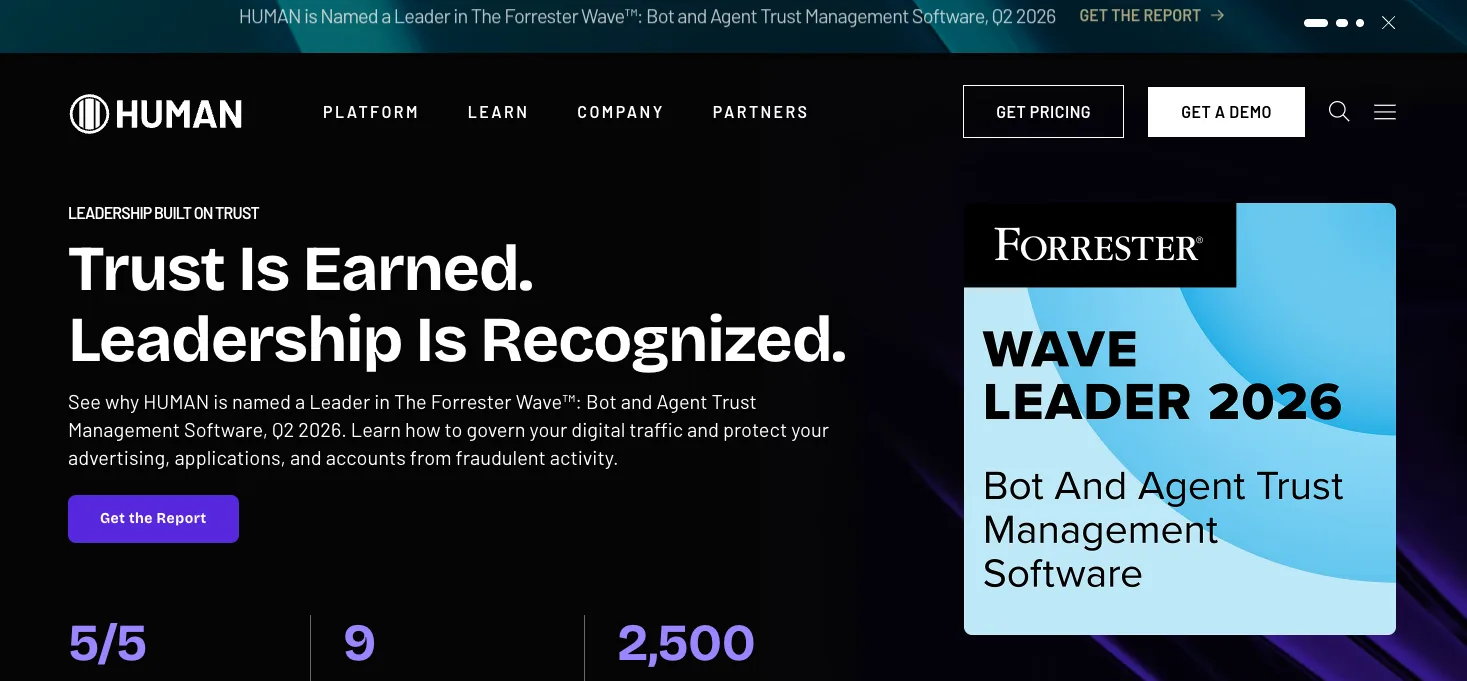
HUMAN Security (Web, mobile, API)
Pros:
- Deep threat intelligence from a very large verification network
- Strong specifically on account takeover and ad fraud
- Named a Leader in the Q2 2026 Forrester Wave
Cons:
- Enterprise-only, with sales-led pricing
- Overkill if your only problem is basic content scraping
HUMAN (which absorbed PerimeterX and White Ops) verifies an enormous number of interactions, and that scale is its edge. When you see billions of events, new botnets stand out faster.
Its sweet spot is fraud that costs real money: credential stuffing, fake accounts, and advertising fraud. If your losses show up as chargebacks and poisoned analytics rather than just server load, HUMAN speaks your language.
The tradeoff is that this is enterprise machinery. There's no self-serve tier, and the platform is more than you need if you're just trying to keep a scraper off a product catalog.
Who it's for: marketplaces, ad platforms, and consumer apps where automated fraud translates directly into financial loss.
HUMAN pricing: Custom, enterprise.
Best anti-bot solution for apps already on AWS
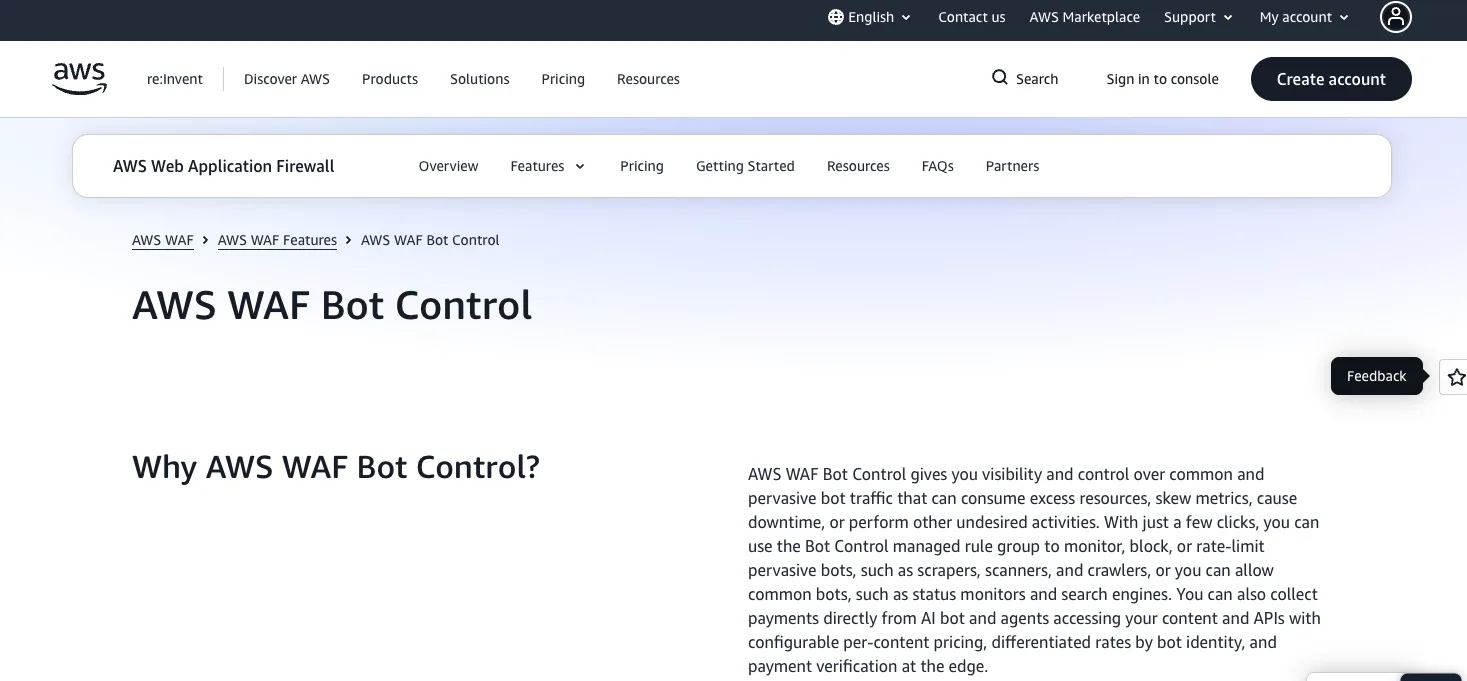
AWS WAF Bot Control (CloudFront, ALB, API Gateway)
Pros:
- Published, predictable pricing - rare in this category
- Targeted Bot Control adds browser interrogation, fingerprinting, and behavioral analysis
- Deploys to CloudFront, ALB, API Gateway, AppSync, and more without a new vendor
Cons:
- Costs climb fast at high request volumes if you're not careful with scoping
- Detection depth trails the specialist vendors on the most determined attacks
If your stack already runs on CloudFront, Bot Control is the least disruptive option here. You add a managed rule group to a web ACL and start classifying traffic - no procurement cycle, no new console.
Two tiers matter. Common Bot Control catches crawlers, scanners, and scrapers that don't hide. Targeted Bot Control brings browser interrogation, fingerprinting, and behavioral baselines for bots that actively evade detection, plus a Challenge action that forces token generation.
The pricing transparency is the real draw. Bot Control runs about $10/month per web ACL, with roughly $1 per million requests for common bots and $10 per million for targeted. You can model your bill before you commit, which you can't do with any quote-only vendor on this list.
That said, per-request billing cuts both ways. Run Targeted Bot Control across every asset on a high-traffic site and the invoice gets ugly. Use scope-down statements to apply expensive inspection only to the paths that matter - /login, /checkout, your pricing API - and skip it on static files.
One recent addition worth knowing: AWS added AI traffic monetization to Bot Control, letting you return an HTTP 402 and charge AI agents for access to your content rather than just blocking them. If scrapers are hitting content you'd happily license, that's a different answer than a block rule.
Who it's for: teams already on AWS who want solid bot defense with a bill they can predict, and who are willing to tune scoping rules themselves.
AWS WAF Bot Control pricing: ~$10/month per web ACL, plus ~$1 per million requests (common bots) or ~$10 per million (targeted). Standard AWS WAF charges apply on top.
Best anti-bot solution for large enterprise on the edge
Akamai Bot Manager (Web, mobile, API)
Pros:
- Runs on Akamai's massive edge network at serious scale
- Long heritage handling huge enterprise traffic volumes
- Fits neatly if you already use Akamai for CDN and security
Cons:
- Typically a separate add-on contract
- Best value only if you're already in the Akamai ecosystem
Akamai Bot Manager rides on one of the oldest and largest edge platforms, which makes it a natural pick for enterprises already routing traffic through Akamai.
Its strength is scale. If you're serving billions of requests across global properties, edge-integrated detection keeps the filtering close to the user and off your origin.
The practical friction is procurement. Bot Manager usually comes as a separate add-on, so budget and contracting are their own project.
Who it's for: large enterprises already standardized on Akamai that want bot defense without introducing a new vendor at the edge.
Akamai pricing: Add-on contract; custom.
Best anti-bot solution for the hardest attacks
Arkose Labs (Web, mobile, API)
Pros:
- Adaptive challenges that stay tough even under heavy attack
- Designed to make attacks economically pointless
- Strong on the most targeted, high-value flows
Cons:
- Challenge-based, so it can add user friction by design
- Enterprise-only and priced accordingly
Arkose takes a different bet than the invisible camp. Instead of only hiding, it can escalate suspected bots into interactive challenges engineered to be cheap for humans and expensive for machines at scale.
The idea is economic: if solving your challenge costs an attacker more than the attack is worth, they leave. Against funded, persistent adversaries, that model holds up where static defenses crumble.
The obvious cost is friction. Challenges, even good ones, sit in front of some users, so this is a tool you reach for on your most abused flows, not your whole site.
Who it's for: high-value targets, large logins, gaming, financial services - facing attackers who won't quit when a fingerprint model flags them.
Arkose pricing: Custom, enterprise.
Best anti-bot solution you can self-host
CrowdSec (Web, API, server)
Pros:
- Open-source and self-hostable - you own and control it
- Crowd-shared blocklists from the whole CrowdSec community
- Free core, with paid tiers only if you want them
Cons:
- You run and tune it yourself; no managed hand-holding
- Won't match a top commercial engine against advanced browser automation
CrowdSec is the outlier here, and the one I'd point a self-reliant team toward first. It's open-source, you run it on your own infrastructure, and it shares attack signals across its community so a bad IP flagged elsewhere gets blocked on your box too.
That community angle is the clever part. No single small site sees enough traffic to train good detection, but thousands of them pooling signals do. You get some of the network effect the big vendors sell, without handing over your traffic to a black box.
Be realistic about the ceiling. CrowdSec is excellent for cutting off known-bad IPs, brute-force runs, and noisy scanners. It won't, on its own, stop a well-tuned headless browser rotating clean residential proxies - that fight needs behavioral and fingerprinting depth the commercial engines specialize in.
Pair it with the OWASP Core Rule Set on a WAF and you've got a credible self-hosted baseline for not much money.
Who it's for: engineering teams that want to own their stack, keep costs low, and control exactly what gets blocked.
CrowdSec pricing: Free and open-source core; optional paid tiers for managed blocklists and enterprise features.
Other anti-bot options worth knowing
A few tools didn't make the main list but deserve a mention depending on your setup.
Imperva Advanced Bot Protection (formerly Distil Networks) is a strong enterprise option, though its bot defense sits behind Enterprise-tier licensing.
Radware Bot Manager shows up often in enterprise shortlists and integrates well with Radware's broader application security suite.
Arkose and Turnstile-style challenge tools overlap with reCAPTCHA and hCaptcha if you specifically want a challenge layer rather than full management.
The scraper's-eye view
Worth saying plainly, since this blog usually sits on the other side of the fence: every tool above is what your scraper runs into in the wild.
The same signals these platforms read - TLS fingerprints, header order, mouse movement, IP reputation - are exactly what you manage when you're doing web scraping without getting blocked. Clean residential proxies from a provider like Roundproxies handle the network-reputation half; browser fingerprinting handles the rest.
Understanding detection makes you better at both defense and evasion. They're the same coin.
Still have questions?
What's the best free anti-bot solution?
CrowdSec is the strongest genuinely free option, since it's open-source and self-hostable. Cloudflare's free plan includes basic bot controls, but the behavioral engine that stops serious automation is Enterprise-only.
Do anti-bot solutions still use CAPTCHAs?
The best ones try not to. Platforms like Blockdash challenge a tiny fraction of requests and stay invisible otherwise, because CAPTCHAs frustrate real users and are cheaply defeated by solving services and AI models. Others, like AWS and Arkose, still use challenges deliberately as an escalation step.
Can bots get past these tools?
Yes, no defense is perfect. Determined, funded attackers using real browsers and clean rotating proxies can slip past most systems. The goal isn't perfection; it's making automation expensive enough that attackers move on.
What's the difference between a WAF and an anti-bot solution?
A WAF blocks known attack patterns like SQL injection. An anti-bot solution decides whether a visitor is human. They overlap and work well together, many teams run both.
Which anti-bot solution should you use?
Start with your actual threat. If you're bleeding money to account fraud, look at HUMAN. If organized bots swarm your drops and on-sales, Arkose earns its price. If you just want strong protection without punishing real users, Blockdash's invisible approach is the cleanest fit.
If you already run traffic through a CDN, check what you're paying for before adding anyone: Cloudflare, Fastly, Akamai, and AWS all sell bot defense on infrastructure you're using today.
And if you'd rather own the stack than rent it, start with CrowdSec and a good rule set, then upgrade only if attackers force your hand.
Whatever you shortlist, trial it against your own traffic before signing. Vendor accuracy numbers are marketing until they're measured on your users.